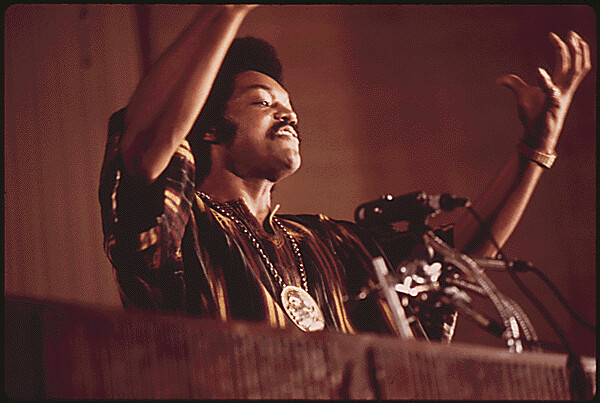
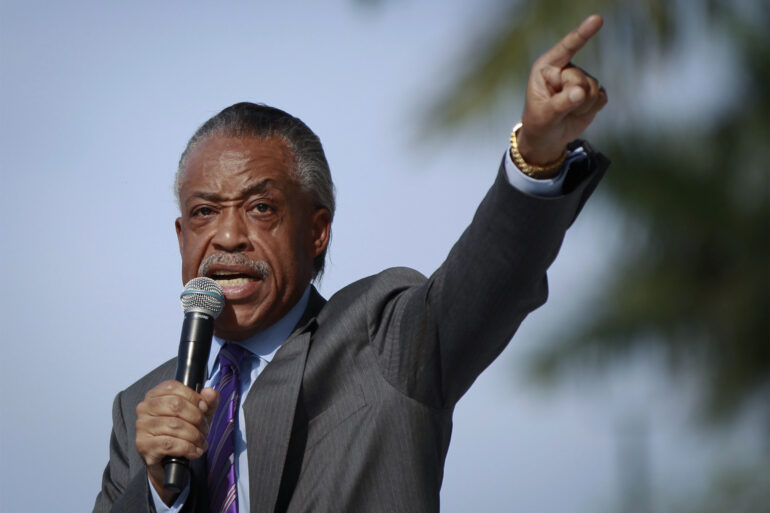
Credit: Eric Guo; cropped by Beyond My Ken (talk) 03:54, 18 May 2010 (UTC), CC BY 2.0, via Wikimedia Commons
URL Media | Ovetta Wiggins
The Rev. Jesse Jackson Sr., a civil rights icon, gifted orator, and politician whose presidential campaigns changed the landscape of American politics, died Tuesday, according to NPR. He was 84.
Jackson, who was initially diagnosed with Parkinson’s disease in 2017, died after a more than 10-year battle with progressive supranuclear palsy, a neurodegenerative condition that affects body movements, walking, and balance.
A protege of the Rev. Martin Luther King Jr., Jackson spent more than six decades fighting on the front lines for racial equality and social justice for marginalized communities, becoming one of the most recognizable figures not only in African American history, but in the nation’s history.
As a teenager, he was arrested for defying police officers’ demands to leave a segregated Greenville library. He would later tell a biographer that the incident was “how I lost my fear of death and jails.”
He marched from Selma to Montgomery in 1965, spoke at the 1995 Million Man March, and founded and led a Chicago-based social justice organization until 2023. In 2020, Jackson was awarded the National Medal of Freedom, the nation’s highest civilian honor, for his work in the civil rights movement.
Former Vice President Kamala Harris described Jackson as someone “who believes deeply in the promise of our country, a fighter for freedom and human rights for all people” during a 2023 event celebrating his retirement from the Rainbow PUSH Coalition and the 35th anniversary of his 1988 presidential campaign.
His 1988 campaign slogan, “Keep Hope Alive,” and his favorite mantra, “I Am Somebody,” became almost synonymous with his name and his legacy. But Jackson also couldn’t escape his detractors, some of whom questioned whether he took political advantage of King’s death in an attempt to fill the void left in the movement.
A son of the segregated South, Jackson was born October 8, 1941, in Greenville, South Carolina, to 16-year-old Helen Burns and Noah L. Robinson, a married neighbor who worked as a cotton grader. A year after Burns gave birth, she married Charles Jackson, who later adopted her son.
In biographies, Jesse Jackson said taunts as a child about his out-of-wedlock birth pushed him to become successful in life.
But in a 1997 New York Times obituary for Robinson, Jackson said he and his biological father later built a relationship, and he ultimately considered him a second father. He said he inherited his “healthy ego” from Robinson.
“It is where I get the drive to think I could change the South through the civil rights movement and run for President,” Jackson said.
Jackson became entrenched in the civil rights movement while attending North Carolina A&T University in Greensboro, where he joined the Greensboro Council on Racial Equality (CORE) and where he met Jacqueline Lavinia Brown, his wife of 63 years.
With CORE, he led sit-ins in Greensboro and later became the group’s southeastern director, positions that became the building blocks for his work with the Southern Christian Leadership Conference, which King led.
In 1966, King appointed Jackson to the SCLC’s Chicago economic program, Operation Breadbasket, designed to improve economic conditions in the Black community. One of its strategies was to boycott businesses that mistreated Black people. Five years later, Operation Breadbasket was renamed Operation PUSH (People United to Serve Humanity).
After his first presidential run in 1984, Jackson launched the National Rainbow Coalition, which sought equal rights for all Americans. At the time, the organization’s main effort was to fight President Ronald Reagan’s policies to reduce domestic spending and to push for social programs, voting rights, and affirmative action programs opposed by the Republican president.
Jackson campaigned for president again in 1988. He shocked the Democratic Party when his campaign gained momentum, not only in urban centers but also in rural farmland.
CNN anchor and host Abby Phillip, who released “A Dream Deferred: Jesse Jackson and the Fight for Black Political Power,” a book that explores Jackson’s political prowess and his presidential campaigns of the 1980s, said recently that “many people thought he was just a gadfly, running just to make a point.” But, she said, it’s about 30 years later that “we have a better understanding of just how much of an impact had.”
Jackson’s 1988 campaign, in which he focused on economic justice and finished second to Democrat Michael Dukakis, would later become a model for other insurgent presidential candidates, including Sen. Bernie Sanders.
“My campaign, to be very honest with you, picked up where Jackson left off,” Sanders told Phillip about Jackson’s strategy to build coalitions and focus on young voters.
Phillip wrote that Jackson’s run, despite being seen as a failure on its face, was the “dress rehearsal” for America to envision a Black president.
Jackson is survived by his wife, Jacqueline, and his six children.